

|
|
Interview: Rising Son by Sharaad Kuttan the Malaysia's Men's Review CARY-HIROYUKI TAGAWA, Star Of Mortal Kombatis interviewed by Men's Review's Sharaad Kuttan. He gives his version of the coming of the Pacific Century, Asian America and the role of violence in setting a positive role model for minority kids. Really. The baddest of the bad; that's the role Cary-Hiroyuki Tagawa plays in the film Mortal Kombat, a liberal film adaptation of the Nintendo game that, along with Streetfighter, has staked a claim at the cinema for the blood and guts video games. It's the kind of film that might appeal to you if you're a fan of the game, of the fantasy genre of film or if the adolescent in you still rules enough for you to be a joy-stick grasping nut. While Mortal Kombat has done fairly well at the American box-office, with mixed reviews, we'll have to wait and see if the rest of us are as eager to swallow Hollywood's latest offering to global culture.
The strapping Japanese-American actor is familiar to American audiences for is appearances in science fiction TV shows like "Star Trek: The Next Generation" and "Alien Nation". He also grabbed attention for the sexually-charged charm which he brought to his character in "Rising Sun"; a film which attempts to make sense of American anxieties over their own perceived decline. However, it is only with his starring role in Mortal Kombat, that Tagawa is set to become a household name for an international audience; a feat few Asian-Americans have achieved. And if the names Susie Wong, Charlie Chan, Fu Manchu and Little Grasshopper come to mind; well the truth is that they really don't count. Tagawa was in Malaysia recently to promote Mortal Kombat; apart from a cameo from Christopher Lambert, many of the other faces are fairly new. The movie which was the top grossing film in the US in from late August to early September, hasn't pleased everyone though. One reviewer panned the movie saying that it was "visually crude and - barring the regal cameo provided by Christopher Lambert - featuring a cast with little more talent than their animated predecessors, [director Paul] Anderson's latest effort will endorse critics of his debut, Shopping, that this is a director with more daring than talent. A techno-rave soundtrack provides clumsy cover for inadequate action." For us who are indifferent to the quality of the piffle that is churned out in Hollywood, a Gomer Pyle response to life is quite apt: surprise, surprise, surprise! Braving the Jalan Ampang traffic, Tagawa arrived at our photo studio with looks, despite being exhausted, that betrayed his 45 years. Tagawa was the picture of calm as he made his way through a litre of mineral water, talking about his work and the things that turn him on, and after a short while regaining his energy. Energy that became more than apparent when the photo session began.
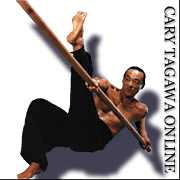
He declined a shoot that was to have him in an authentic samurai outfit. I sat watching him as he looked at the suit with what I thought to be a kind of sadness. I asked if he understood the symbolism attached to the suit. "Too much," he said turning from the suit. It's moments like that which contrasted with the his almost hyper-masculine barring and the display machismo from the shirtless torso, and black jack boots to the push-ups which pumped his atypical Japanese frame up to awesome proportions for the shoot.
"Put some music on, something with energy," he said drawing out the syllables on the word "energy" in an almost stereotypical Asiatic drawl. With a housed-up Wagner in the background, Tagawa worked with the camera, and left all of us - photographer and make-up person included - breathless from his energy and professionalism. It isn't just surfaces that one is dealing with when engaging with Tagawa, though its clear that he is conscious of his body and its presence, and knows how to manage it. At his most disarming when he laughs, Tagawa betrays the wealth of experience and attentiveness to the presence of other sentient beings that comes from having lived fully. He's the kind of person that makes you ask that impossible but necessary question: what makes Cary Tagawa who he is? Tagawa was born to Japanese parents - his father, who worked for the US military in Japan, is from Hawaii and his mother, an actress, from Tokyo. They moved to America when Tagawa was five. "It was such a shock, moving out of a loving supportive Japanese society into the American south of the 50s," said Tagawa, whose later attempt to return and recover this Japan of his childhood failed. He left the US prepared to return and settle in Japan, but found a society that would not accommodate someone like him who hadn't been through their struggles of the preceding years. He explained that his father's family had come with the first wave of Japanese immigrants into America in the 1800s. The second wave constituted mostly brides of servicemen after the second world war. In a recent film, Picture Bride, Tagawa played a farmer who orders a bride from Japan. The film, which was shown at the Cannes Film festival in 1994, won the Audience Award at Robert Redfords' Sundance Film Festival in Colorado. "I did it because it was a story that needed to be told, and it had a first time director. It was a heart project," explained Tagawa, who you can believe when he says that his commitment is to the medium, to being an actor and not to being a star. "Hopefully there'll be more of such films; it's sad that this is the only kind of venue for such films," he said of Picture Bride which played the limited art house circuit. Tagawa, who will also be seen in a cameo role in the Paramount pictures The Phantom was in Singapore recently to sign a deal with a film company there, for a movie that's yet to be given a title. "It's about a Vietnam vet who comes to Singapore in search of the grave of his father, a world war two soldier. I'm writing the script," he said, describing the film as an exploration of the gap between father and son, between World War Two and the Vietnam War. Coming in part from his own relationship with his father, of whom he didn't see enough, Tagawa, whose wife and two children reside in Hawaii, is very conscious of his own relationship with his seven-year-old boy and four-year-old girl. "It's about quality time, since I have to be away from home. But I've decided to spend more time at home, to do more writing and independent producing rather than chasing Hollywood," says Tagawa who waited 16 years after leaving university before getting into Hollywood. "I think it's viable; I'm counting on the rising Asian market, the amount of resources available to make a film. And the talent that is out here," he adds, saying that he doesn't think Asia is represented enough internationally in the film industry. Tagawa is very conversant with Pacific Century-speak, although he believes that the links made by artists are more likely to yield a vibrant multi-cultural milieu than those established by business, which he says often lead to "competition and war". Tagawa's talk of "believing in Asian values" comes out of his own attempt to grapple with his crisis of identity. One of the criticisms that can be levelled against Tagawa is that the characters he plays are "bad" and therefore create negative images of the Asian community. "I'm asked, if you believe in peace and creativity than why do you do violent films. There are different perspectives on this issue. I believe that there are many ways to create change. One is not to do these films. I honour that choice and I have no disdain for them as they have for me. Rather than turning away the opportunity I have been given, I have decided to use it and to play it to its best dramatic effect, to play the baddest, bad guy." But Tagawa's position is not just a retreat into a professionalism, and the ethic of doing one's best. He has worked out an interesting reading of the cultural politics of these images of "good and bad" which should make his critics stop and think. Referring to the New Age movement in the US, Tagawa explains that some people want to attain a high spiritual plane immediately, and contrasts his own project as working from the "lowest common denominator". "Violence has the greatest appeal worldwide and you can see that in action films. Part of it is a necessary release of the frustration of everyday life," explaining that this is the point from which a consideration of the issue has to begin. Tagawa recognises that his playing a very successful bad guy has allowed young people to identify with him, and he hopes, not the violence. At this point one might be tempted to dismiss Tagawa either as a mistaken idealist to believe that such a distinction will in fact be made, or as a cultural charlatan. But Tagawa does more than "wish"; he is actively meeting with youths and engaging with them. "Kids come to me, mostly minority kids, blacks, Hispanics and some Asians, really idealising my character. You see the "good guys" represent all that is oppressive in their lives, and to have the good guys lose is very significant," asserts Tagawa who acknowledges that this a serious indictment of a system that alienates substantial segments of its population. "I go to schools and talk to kids, bad boys, and what I say is opposite to what I portray," says Tagawa, who also works with an alternative school in Hawaii, and hopes to further his involvement as an educator. Talking to Tagawa one senses the maturity that comes from years spent accumulating experiences and exposing oneself to a range of people, a process he sees as essential to becoming a good actor. This repertoire of emotions is not merely evident on his face - which morphs from the scary to the child-like laugh with infinite ease - but also in his negotiation of the film industry, and his commitment to take responsibility for the role he plays in this powerful medium. Talking to Tagawa is an engaging experience; and one can only hope that many more individuals in the industry understand, as he does, the good that they can do from where they are at. |
 |
|||||||||||||||||||||||||||||||



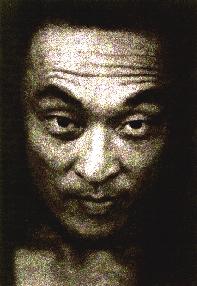 What isn't in doubt is that the one
good thing about the movie is Tagawa, who describes the character he plays in
the movie, the evil Sorcerer Shang Tsung, as a "multidimensional evil";
a character he imbues with his charismatic presence. More importantly, Tagawa's
charisma extends beyond the screen in his work with young people, as a martial
arts exponent and as a person whose critical take on the power of popular culture
gives him equanimity in the face of the immense seduction of the Hollywood system.
What isn't in doubt is that the one
good thing about the movie is Tagawa, who describes the character he plays in
the movie, the evil Sorcerer Shang Tsung, as a "multidimensional evil";
a character he imbues with his charismatic presence. More importantly, Tagawa's
charisma extends beyond the screen in his work with young people, as a martial
arts exponent and as a person whose critical take on the power of popular culture
gives him equanimity in the face of the immense seduction of the Hollywood system.